
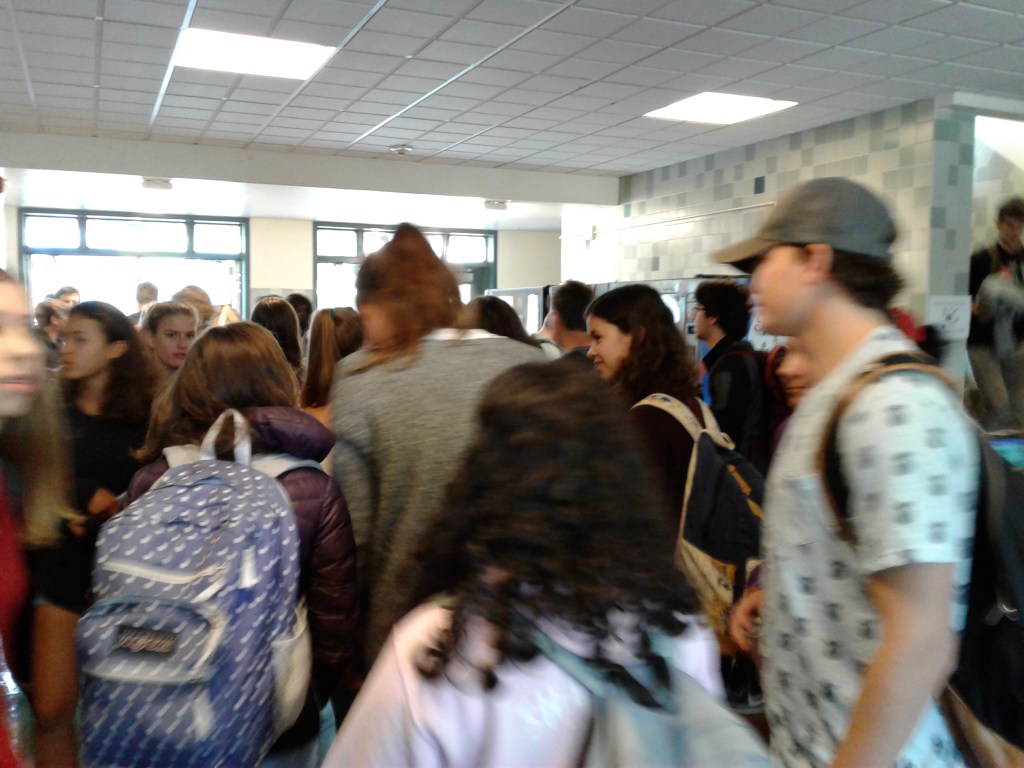
Every school day, students find themselves in the same situation: arriving late to class. During passing time, the hallways are packed with students trying to get out of their last class and rush to the next. People walk slowly and sometimes even on the wrong side of the hallway, causing a traffic jam. A prime example of this is where D-hall, E-hall, and J-hall connect, and students come from three different directions at the same time. With so many people trying to get through one area, students have to stop, wait, or squeeze past each other just to continue walking. Students shove each other into the walls as though their lives depend on getting to class on time, just to somehow still end up late.
A big part of the problem is that students have different amounts of time depending on where their class is located. Some students only have to walk a short distance to their next class, while others have to travel across the school. Four minutes may be enough for someone whose classes are next to each other, or who is released right when the bell rings, but it can be more difficult for a student who has teachers who teach to the bell and have to pack up while the next class is filling in. Even if these students leave their classrooms immediately, they can still arrive late because of the number of people in the hallways.
“Sometimes, the hallways are so crowded that you can barely get through,” said junior Ava Cubelli, “even if you are trying to walk quickly, you are still stuck behind huge groups of people.”. When so many students are trying to move in different directions at once, it becomes difficult to control how quickly you can get to class. Another issue is when students have classes far apart from each other, and no matter how fast they walk, they are still late and get a tardy.
“It is frustrating getting tardy when you are genuinely trying to get to class on time, but your classes are on opposite sides of the school,” said junior Zoey Chakraborty. Students should not feel like they have to rush through the hallways or worry about receiving a tardy when they are making a genuine effort to arrive on time.
Teachers don’t give students enough grace when they are late. Oftentimes, teachers immediately assume that a student is purposely taking a long time to get to class, when there could be a legitimate reason for their delay. A student could be stuck behind a large group of students, coming from a class that is far, like the gym or going from the cafe to G-hall, or waiting for the hallway to clear because they cannot even see past the sea of students. While students should be responsible for getting to their class on time, teachers should also recognize that not every tardy is caused by a student being irresponsible. Another problem occurs when teachers aren’t aware of exactly when class ends. Students sometimes have to rush to pack up their belongings once they hear the bell. This also means the next class has to wait outside in the hallway for the previous class to walk out, causing even more hallway chaos.
There are several ways this issue could be improved. One solution would be to extend passing time between classes. Even adding a few extra minutes could give students more time to travel across the school without having to sprint through the hallways. Another option would be for teachers to have a 5-minute grace period for students who arrive shortly after the bell. This would not mean that students could purposely take their time, but it would give students some flexibility when the hallways are especially busy. Getting to class on time should not feel like a race every day. Students should be expected to be responsible and make an effort to get to class, but the school should also recognize the challenges that come with crowded hallways, distant classrooms, and limited passing time. Giving students a little more time or allowing a short grace period could make passing time less stressful and help reduce the hallway chaos that students experience every day.



Leave a Reply