
On Oct. 27 and Oct. 28, 2026, all Masuk students enrolled in a physics class tested catapults built during the past month. Students worked either as individuals or in small teams to build a catapult that demonstrated physics concepts.
“The purpose of the project is an engineering and design challenge. I think students can learn a lot about how a plan can sometimes not go the way they think it would go, and they have to fix things, and change their plans, and problem solve on the fly,” said Masuk physics teacher Victoria Cardoso.
Students were assigned with the task of building a catapult or other launching device with the goal of achieving maximum performance on two tests. The first test was a short range test, with a distance of 11 yards (students were told the short distance test would be selected from 10 to 25 yards on test day). The second test was a long-range test, where students competed to launch the projectile, a small ball of non-hardening clay, as far as possible.
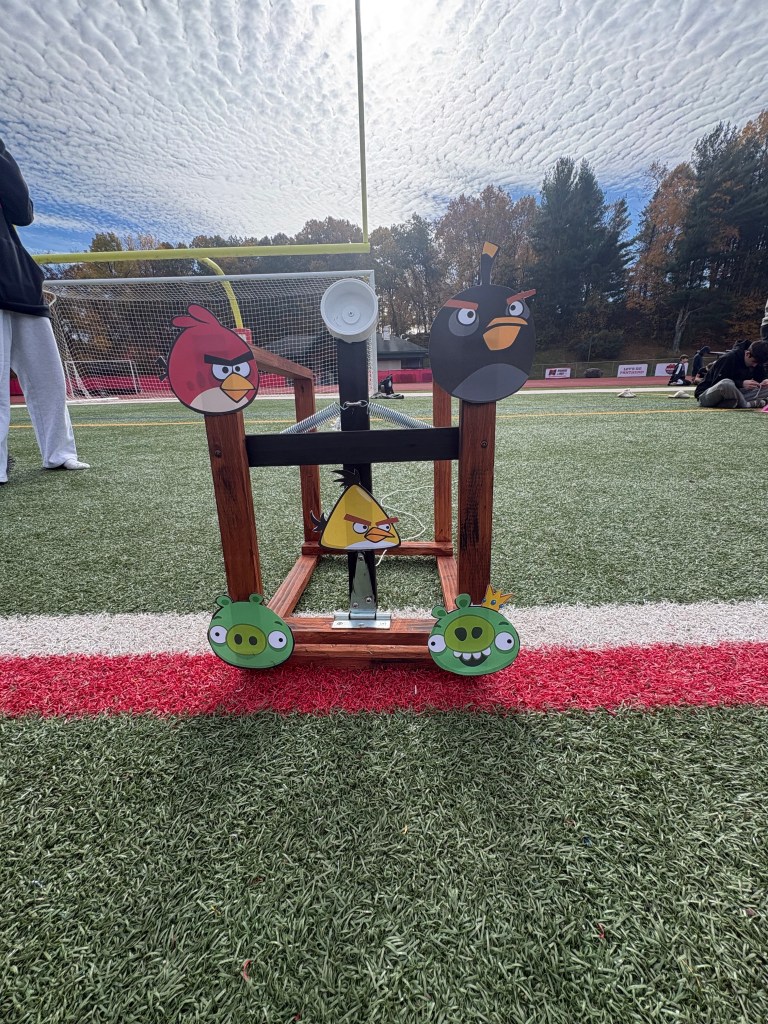
Students were required to design the catapults to a certain design criterion. The criteria required a mechanical trigger, which allows the launcher to load and launch without the student holding the arm down. Students also had to make the launcher adjustable by altering the force, launch angle, height, or release point the projectile launches at. The launcher had to also be smaller than 0.5m (~19.68in) by 0.5m by 0.5m, or about the size of a small mini fridge.
Students were judged on an average of their rank on the two events, creating one single score. Students’ scores were used to award the ranking points of the final grade, with 10 points being awarded to the first place winners, nine points to the second place winners, and decreasing by half-point intervals until sixth place with a minimum score of seven points for all qualifying teams.
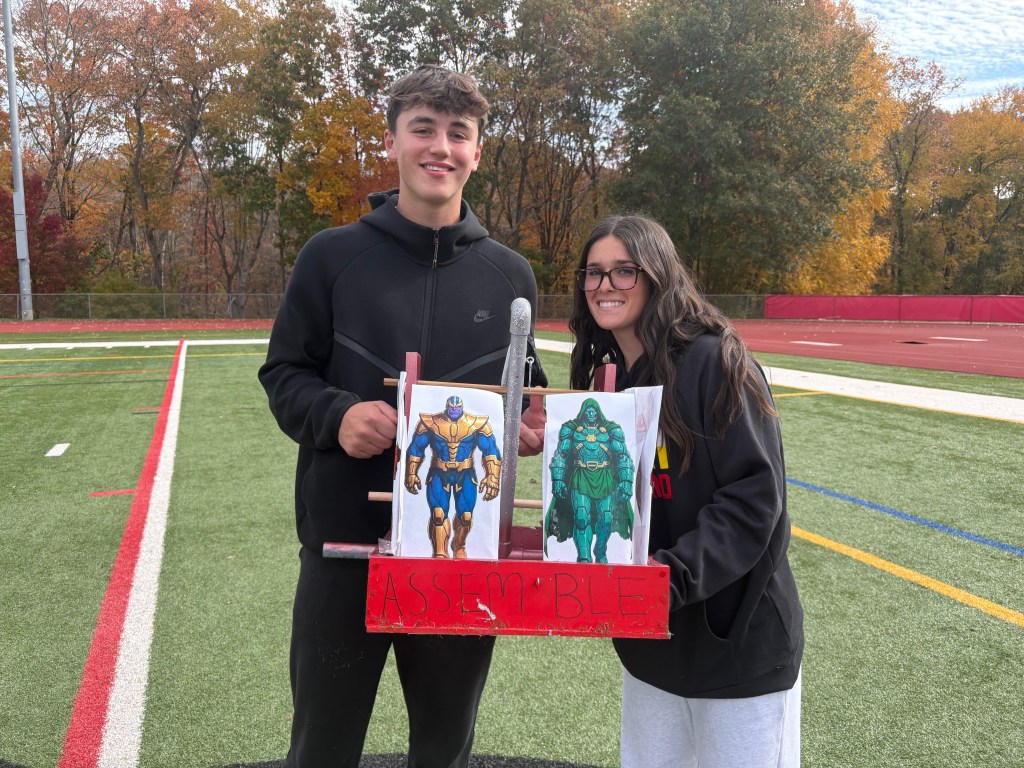
In addition to the two pre-planned events, students were also offered the opportunity to score a field goal with their catapults. The goal of this event was to test if the catapult was adjustable to give a shorter distance with more air. Students who successfully scored in this category were awarded an extra bonus point.
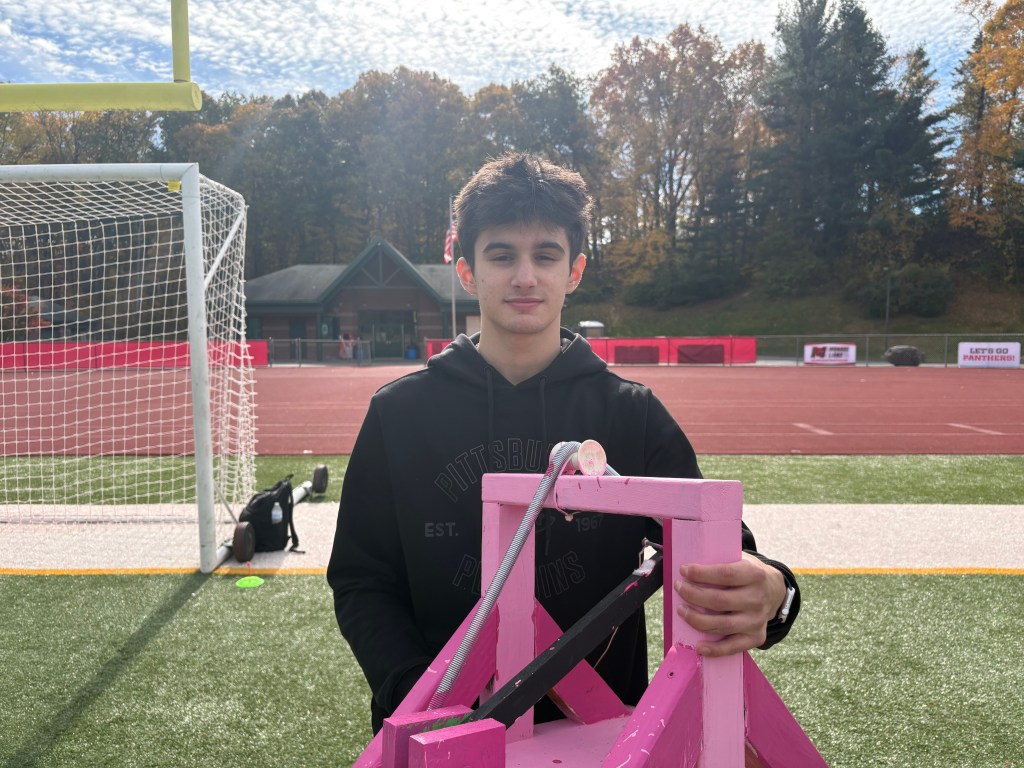
“We put a lot of effort and time into finding a good design that could meet the criteria in size and support the power and force needed to launch the projectile far enough, but obtain the force and stay sturdy,” said Masuk junior Nathan O’Hara, who was on Team USA, winners of Cardoso’s fourth period class.
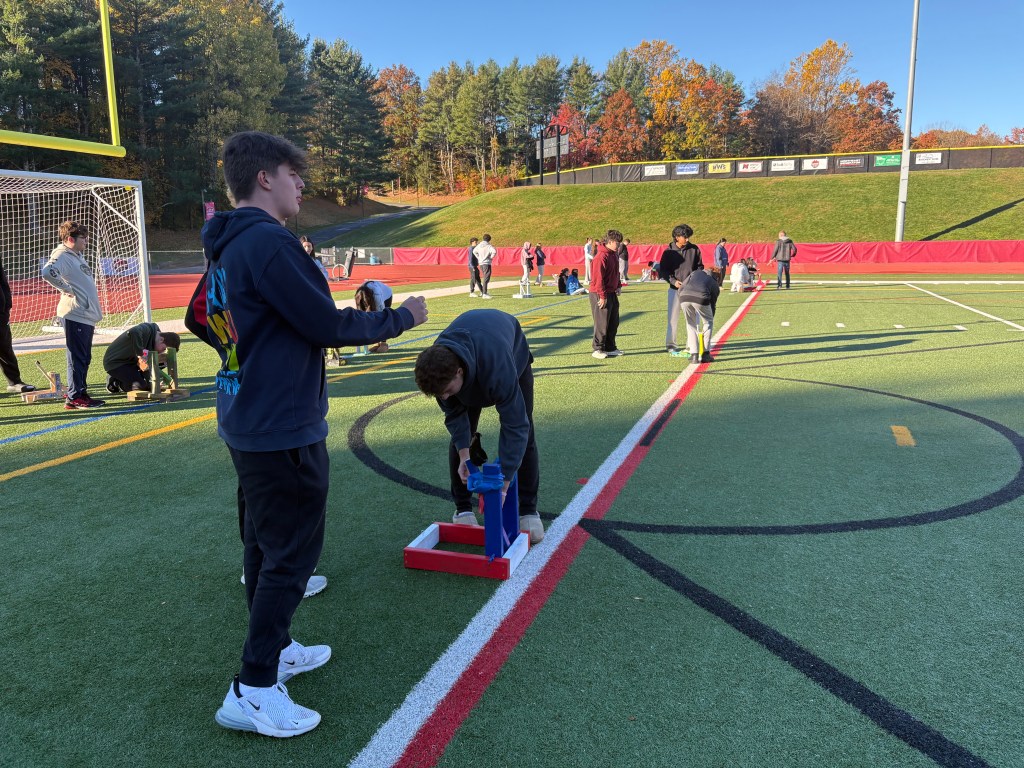
The event was held as part of Monroe School District’s Vision of the Graduate program, which is a series of five core competencies with the goal of giving students a head start on the real world and college experiences through critical thinking and problem solving, curiosity, communication, empathy and compassion, and social-emotional readiness.
The catapult project was mainly focused on critical thinking and problem solving. “That is a big part of this project, in addition to understanding the ideas of motion.” Cardoso said.
With the event wrapped up, students submitted their reflection logs on their strengths and weaknesses with the project, and what they learned and needed to do differently next time. While some teams scored better than others, everybody involved took away information not just about physics, but about real world problem solving. Students enrolled in physics classes will have many more events like this one to apply the knowledge they learned and use those steps again – before going out to use that knowledge in the real world.


Leave a Reply