
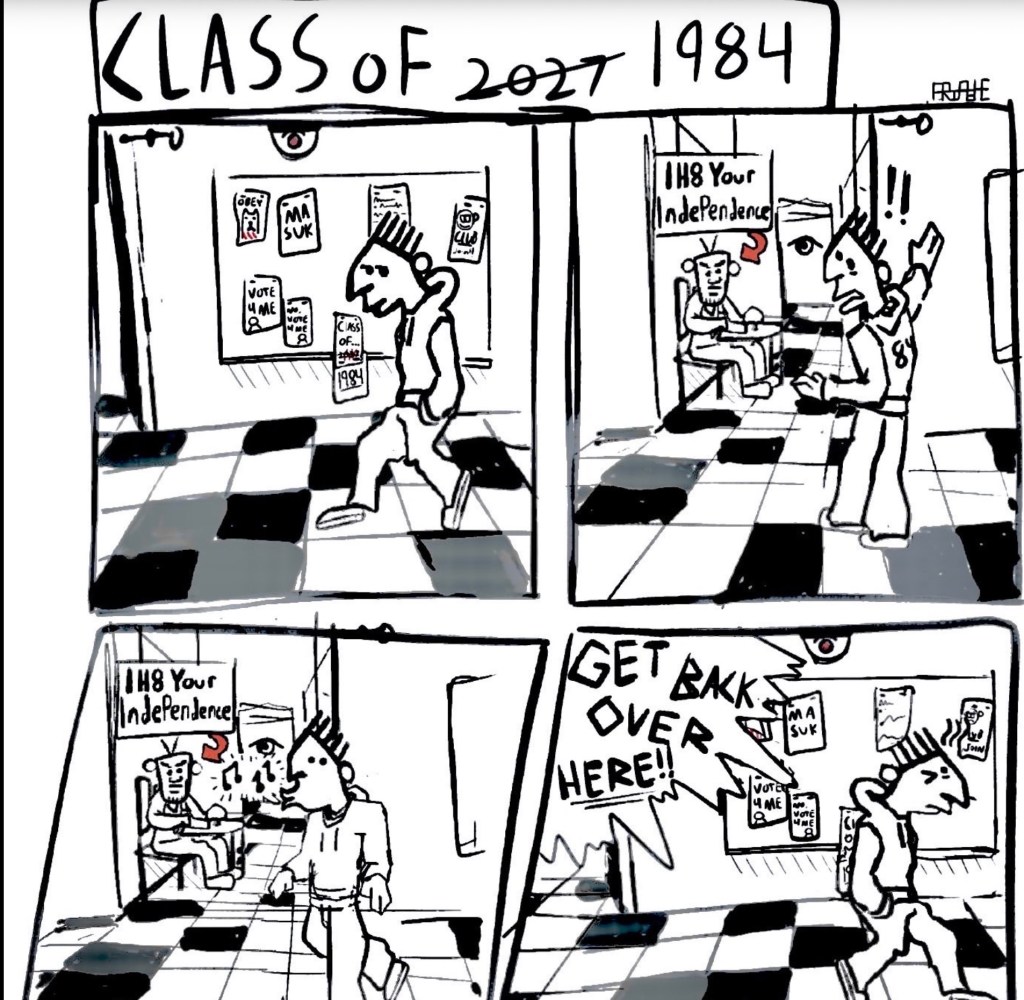
After returning from a beautiful summer break, the seniors of Masuk High School -though determined to eventually escape-were excited to begin their final year of school and enjoy it as much as possible.
Their plans, however, were somewhat derailed with the implementation of new rules that have restricted their previous freedoms around the school, ones that many feel they have earned the right to keep.
For at least the last three years, students have been given certain privileges that, while technically going against school rules, were not heavily enforced. We were allowed to walk around during lunch, go to the cafeteria during class to get some much-needed food, leave the study hall to go to the bathroom or a teacher without being questioned or forced to leave our phones behind and so on.
Again, while those little pieces of freedom were technically not in line with school rules, those little moments mean a lot to students, but we’ll get to that shortly.
A study made available by the National Library of Medicine suggests that increased strictness in schools does not necessarily reduce the number of incidents those schools experience. The study done by New Mexico State University on school discipline and disruptive classroom behavior found that,
“Normative perspectives suggest that compliance depends upon commitment to rules and authority, including perceptions of fairness and legitimacy. While perceptions of fairness also predict lower disruptions, the effects are mediated by positive teacher–student relations.”
In English, this means that rule-following is more likely to take place if the people- also known as high schoolers- believe that they are being treated fairly and respectfully by their teachers and schools.
We live in the United States of America, a country famous for its independence against the unjust rules of an island thousands of miles away, but our school system is a much smaller replica of that same situation.
Students have no say in the rules made for them that could make their lives better and improve their school experience, and the administration, which has no student members, does not and cannot understand our perspectives.
Maybe that statement is a little dramatic, but I’m a teenager so I think I can get away with it.
More importantly, these rules have real and negative consequences for students who have been in the school for years already, and even the ones just now arriving. So, following in the footsteps of the Founding Fathers, let’s layout our own list of grievances against our school’s new rules.
FLEX, which is already a minimized part of our school week, has been cut down even more. If a student can’t get a pass to go see another teacher when they need it, they lose important opportunities to get help, participate in activities or do work.
We’re no longer allowed to go to the cafeteria during classes, even though we ask our teachers first. This is an unfair move to control our behavior. Most students don’t eat before they get to school, and who knows if they ate at all last night or if they will later? Refusing to let them get that small bite to eat may be putting a stop to a minor inconvenience for teachers, but it can mean a day of hunger for a student.
Does the school have complete control over the guidance office? No. Does that mean we shouldn’t be allowed to have our phones? Also no. When we go to guidance we go because we need help with school or other issues. Our phones hold so much of our lives and make it easy for us to bring our problems to the people who are supposed to help us fix them. Taking them away in what is supposed to be a safe space is quite a choice to say the least.
Many students feel that these changes negatively affect their school experience, but they are not empowered to make any changes.
Sure, we have class officers, but they’re focused on Homecoming Week themes and fundraisers, the easy and fun traditions, not actual activism for the students. There are political clubs at Masuk, but none that try to facilitate conversation between the students and administration. One complaint from a student is easy to brush off, but a barrage from an entire group, not so much.
Students need to stop rolling over to every new policy enforced by the school. We go to an amazing school in a great town in a great state, but that doesn’t mean we can’t have a say in how we are treated.
If the school can overhaul the schedule system, enforce new and old policies, and make major improvements to the infrastructure, students can find their voices and make changes where they want to. It’s important that we break the cycle of complaining and doing nothing, because if we want to see change in our school we have to do something about it.
The students need to respect the school, but the school also needs to respect the students.




Leave a Reply