
While you are navigating the streams of teenagers walking through the Masuk hallways, you may be struck by some new additions to the bulletin boards around the school. Turning Point USA and The Three Arrows Club are two new clubs that have joined the other hundred-something we have already, but what makes them so noteworthy? These clubs diverge from the norm of ethnic or similar school or sports-related interest clubs; they are formed around the basis of political thought. But that is not where their stories end-or even really begin.
“When we started the chapter after the assassination of Charlie Kirk, we really got inspired to get out there and start promoting everything he stood for,” said sophomore Aiden Krynski, the Vice President of the Masuk Turning Point USA chapter. “It almost felt like we were being silenced (when they killed Charlie). So instead, we wanted to be louder than ever before, and we wanted to be heard here at Masuk High School. We also wanted people to start talking about politics and getting points across in a way that’s not attacking somebody you disagree with.”
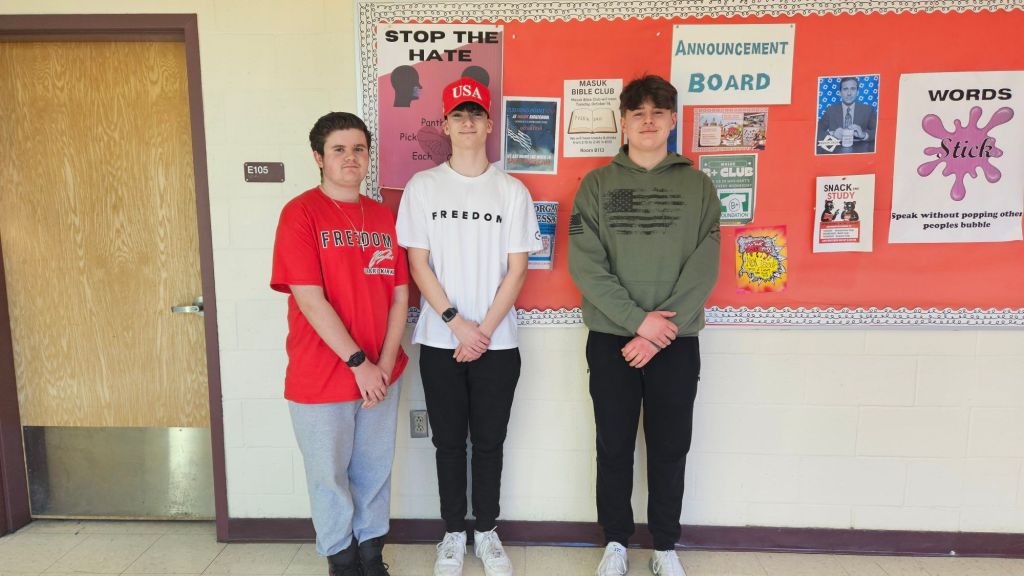
The Turning Point chapter at Masuk was only founded a few months ago, and while it was done in response to the murder of Charlie Kirk, the Three Arrows, another club, was formed in response to them. It was also created very recently, by students who wanted the school to have another option besides Turning Point when it came to political clubs.
“We started this club because we heard that there is a Turning Point USA club, and we just wanted to give the school a balance, because we don’t want this one idea to be dominant or have so much traction, we just want people to have a place to go to if they differ in views,” said sophomore Alaina Sy, Vice President of the Three Arrows Club at Masuk High.
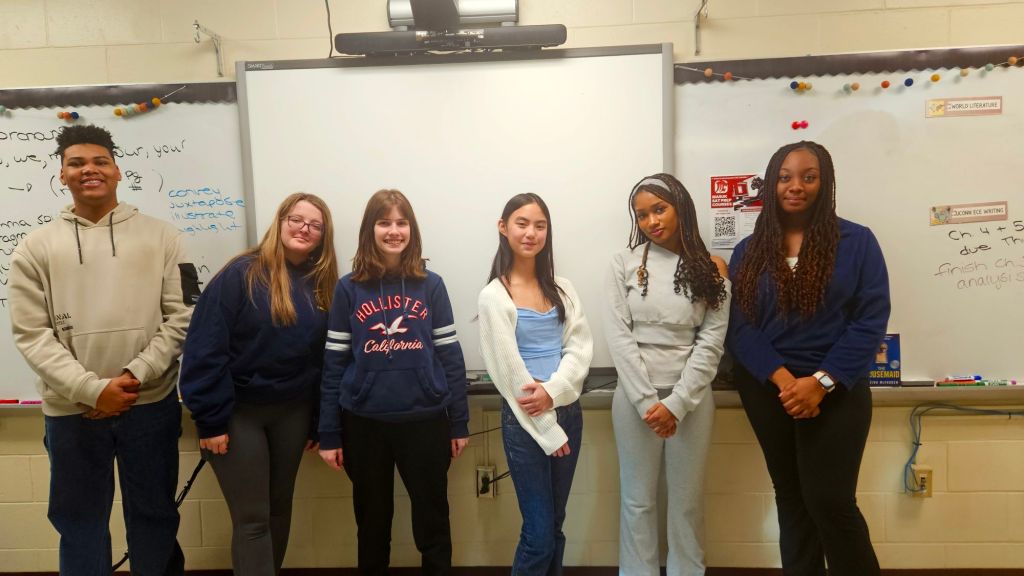
If you have never heard of the “Three Arrows” before now, that’s ok, not many people under the age of 85 living outside of Europe would.
“It is a symbol that stems from a political movement in Germany,” said Allyson Femia, the advisor for the Three Arrows Club and English teacher here at Masuk. “It was like [a] democratic movement against Hitler and the Nazis, so it’s just kind of a symbol of I think democracy, to my understanding.”
Over the years, as students have come and gone, interests rising and falling, political clubs came about as almost trendy social societies that went away as soon as their founders graduated because no one bothered to carry them on.
Already, like many others, you may be wondering, “How can schools have political clubs?” and, more importantly, “What are my actual rights as a student in regards to free speech?” We only have to look as far as our principal, Steven Swensen, and his towering figure to answer these questions.
“Students don’t give up their freedom of speech rights when they walk in the school; it really depends on what it is, they can share their political views, I can’t squelch that nor would I,” says Swensen. According to Connecticut state law, Swensen can only regulate speech when it “reasonably forecasts sustainable disruption or material interference with the educational process, or invasion of the rights of others.”…it goes for all students irregardless of whether they are in a club or not.”
It’s not just Mr. Swenson who supports our freedoms of speech, but also other members of the Masuk faculty, such as the advisers of these new clubs, and even those who aren’t.
“Regardless of my own political affiliations, I will always encourage students to become involved politically,” said Mrs.Femia. “Regardless of side of the spectrum, you guys are only a couple years away from being of voting age and being out in the real world, so I think the more educated and knowledgeable people can be, the better.”
In other words, some teachers instruct us about the rules surrounding our free speech, others allow us to put it into practice. And when it comes to having these kinds of clubs at Masuk the staff here are no exception.
“I think most people have some political view, you have people that have differences in views, and that’s in everything, and they should (anybody) should be able to speak their view and their opinion of the view, whatever issue it may be,” said Robert Pagel, advisor for TPUSA at Masuk. “So, we have a club that has a view, there is another club that has a different view. There is a Jewish Club, there is an African American Club, there are all sorts of different clubs, they all have different views on different topics, and everybody should have the ability to have free speech.”
As a student, you should be aware of four Supreme Court rulings regarding your freedom of speech in school. There is Tinker vs. Des Moines, the ruling of which states that students do not lose their First Amendment rights when they go into school, and in order to suppress any speech the school must prove that the speech would “materially and substantially interfere” with the school in general. That ruling came because the Tinker siblings as well as another student wore prohibited black armbands to their school as part of the opposition movement to the Vietnam War and their school sent them home until they agreed to no longer wear the armbands.
After that, Bethel School District V. Fraser, which says that vulgar and lewd speech can be prohibited and that doing so does not go against the First Amendment. This case was brought before the Supreme Court because a student named Matthew Fraser had used what people believed to be inappropriate words while giving a speech in support of his friend who was running for a student office.
Next, we have Hazelwood School District V. Kuhlmeier, (this one is about student newspapers, yikes!) and it says school sponsored newspapers can be censored or controlled by the school. The principal of the school in the case had ordered two pages from its newspaper to be withheld from publication, and three former students of the school subsequently brought the case to court.
Finally, there is Morse V. Frederick. In this case, a student had hung a banner that read “Bong Hits For Jesus” and school officials both removed it and punished the said student, Joseph Frederick. In the end, its ruling made it so that school officials can prevent students from displaying messages because political speech does not extend to pro-drug messages.

“The idea here is, when students walk into the building, there are some constitutional rights they give up but they don’t give up all of them,” said Susan Clark, a social studies teacher here at Masuk.
“And so the impact of these cases, they began to outline what constitutional rights students retain and what they give up, and most of those cases especially with the first amendment [and] free speech, that is the idea of codifying what could be printed, what you can say on campus versus what you can say at home is different, but it still also keeps in line with other court cases that have established parameters on free speech outside of schools.”
You learn about all of these in AP U.S Government, but for those you reading this who have not sacrificed your health, social life and sleep to pass that AP exam, (sorry Mrs. Clark and Mr. Parkhurst), you should probably take 10 seconds out of your time to read about these decisions in more detail.
Though these rulings have all been around for many years, freedom of speech in schools has continued to be a constantly changing and controversial issue. From books to art to symbols, it has been challenged in places all around the U.S., While we all, of course, root for our fellow students, they are not always the winners of those heated battles like in Morse V. Frederick.
The purpose of free speech in school is so that students can freely share and express their opinions with one another, and clearly, many Masuk students have taken the opportunity to do so.
“If people disagree with me it’s like whatever who cares,” said Krynski. “I just like to see people talking respectfully, and being like ‘oh I don’t necessarily agree with you, but I respect your views and opinions’.
It is important to remember that we as students have rights that cannot be taken away by our school, and that maybe in the future we should seek to exercise those rights a little more than we do day by day. One benefit of these new clubs is that it is more possible for some to do that now compared to before.
“I tend to not express all of my feelings because I think there is a time and place,” said Sy. “I feel like some students might be apprehensive or might want to argue and debate about my personal beliefs, and that is 100% ok…so I think that is a perfect reason why we need this club because I know a lot of people don’t feel as safe as they could be in sharing their ideas.”
Students at Masuk High School need to remember that they too have a voice in their world. Even if neither of these clubs is right for someone, all of us must realize that there is a great extent to which we can express ourselves in this school, and even if you don’t want to take advantage of that, everyone should at least carry it in their back pocket, just in case.


 Masuk Free Press
Leave a reply to Katelyn Cancel reply