
With just a few keystrokes, anyone can generate videos of events that never happened or images of people who never existed. With a small description of a person, AI can create exactly what you asked for. It shows a picture of a person who doesn’t exist. These creations can look real enough to fool almost anyone. In schools, students are using AI tools to help write essays, summarize readings, or generate ideas, raising many questions about honesty and whether their work is really authentic. At the same time, AI-edited pictures and clips spread quickly across social media. As this technology grows, it becomes harder to know what is real and what has been digitally invented.
One of the biggest concerns is how quickly AI can blur reality without people noticing. A video that appears to show a celebrity saying something controversial, or a photo that seems to capture a major event, can spread online before anyone checks whether it’s real. This can influence opinions, create arguments, and even shape public beliefs based on something that never actually occurred. Students, when given an assignment on technology, are most likely to open up ChatGPT or other AI sources as well to write it for them or get help. Parker Driscoll, a junior at Masuk High School, said, “I think AI helps and hurts at the same time. AI shouldn’t be writing people’s essays, but you could use it to get ideas.” It’s great for getting ideas, understanding something better, or getting unstuck when you don’t know where to start. But when people let AI write their whole essay, it kind of defeats the purpose of learning. So, the point isn’t that AI is bad, but that it should be used as a tool to help you think, not to replace your thinking completely. Amanda Gallagher, an English teacher at Masuk High School, said, “I think AI is very useful, but we need to focus on teaching students how to use it for good. It’s easy to have AI write a whole essay, but what is that really teaching you, and at what cost?”
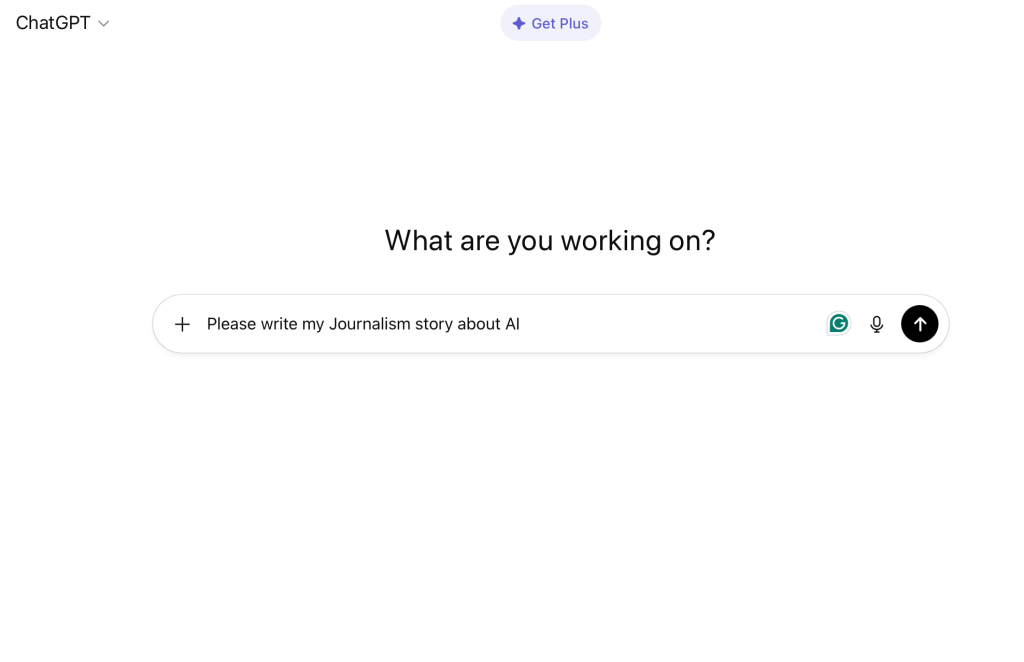
It’s tempting to just let AI do the writing for us, but then we’re not practicing our own thinking or creativity. Masuk freshman Adriana Korczeniewski said “AI really helps me think more creatively, it gives me new ideas I wouldn’t have thought of on my own.” If we learn to use it the right way, AI can actually help us become better learners instead of replacing the work we should be doing ourselves. As a Masuk sophomore, Cole Henderson said, “AI helps me study and understand things in clearer, simpler terms. I don’t use it just to get the answer, I use it to actually learn and make sense of what I’m studying.” This perspective reflects how many students are beginning to use AI more positively and educationally. Instead of relying on it to do the work for them, students use AI to break down confusing topics, check their understanding, and get explanations in plain language. It’s not about avoiding effort, it’s about using technology to help learning and build confidence in subjects that might feel overwhelming. Masuk Senior Lorenzo Matthews-Dixon says, “AI always helps me brainstorm ideas, reword a statement, and just get to an idea.” The majority of students use AI to brainstorm new ideas. Students know to use AI for good and not to use it for bad; it only hurts themselves and nobody else.
Jamie McKee, a Masuk High School English teacher, said, “In my view, it has become a crutch that people depend on rather than engaging in real work.” Instead of thinking critically or doing their own work, they depend too heavily on technology.
Many teachers also use AI to help make their teaching plans and other quick assignments. Stephen Casinelli, an English teacher at Masuk said, “I have so many ideas, and AI helps me put them all together. I use it when I’m stuck, which is the right way to use it.” According to the Harvard Graduate School of Education, in the report’s quantitative study, half (51%) of young people ages 14–22 reported using AI of some sort at one point, but only 4% claimed to be daily users. The most commonly reported uses for AI were getting information (53%) and brainstorming (51%). Many students turn to AI to help, not hurt. They use it to brainstorm and focus on the learning aspect of cheating. As AI becomes more common in classrooms, students and teachers are still learning how to navigate its role in education. In the future, AI is only going to continue to grow in academics and other aspects of education.


 Masuk Free Press
Leave a comment