
Valentine’s Day might be a day of love, but in 2026, it’s going to turn into one of hate for a particular crowd. Why, you may ask? Emerald Fennell, the director behind “Saltburn” and “Promising Young Woman,” is going to release her latest ambition: a new film version of “Wuthering Heights,” a book that was initially released in 1847 and has had a handful of adaptations based off of it since then. But for all of Fennell’s former success, this movie looks like it’s going to be anything but promising, and will inevitably crash and burn.
The primary issue with the film is that White Boy of the Week, Jacob Elordi, was cast as Heathcliff, the male lead. To which I say, Jacob Elordi. Really? A large part of Heathcliff’s storyline comes from the fact that he isn’t white. He is a character in a book set from 1770-1802, meaning that every single character in the book is racist. Heathcliff’s heritage can be strongly felt while reading. His motives, actions, descriptions, everything right down to the way that the man thinks, is all influenced by him being a person of color in an entirely white social group. He is rejected time and time again, told that he is less than, or “other,” somehow. Because Heathcliff is now white, his entire villain origin story ceases to exist. His narrative cannot be told effectively from a white guy.
There is no excuse for this choice. Giving the role to a caucasian man who is already undeniably famous does not make sense. Any argument of “but maybe he pulled off the role in a beautiful and unique way” or “but aside from race, he matches Heathcliff!” is hollow. No protesting can replace the fact that this story was supposed to belong to a person of color, but was handed to a rich white guy.
Emerald Fennell’s directorial work is well known. Her take on “Wuthering Heights” will garner attention just by having her name attached to it. This could have been an opportunity to give the spotlight to a book-accurate actor who would have played Heathcliff in a way that matters. Fennell’s lazy casting will not only change the movie’s meaning, but also alter its public reception in a society that is not well versed enough in classic literature to know the basic plot of “Wuthering Heights.”
The crimes of the casting department do not end there. This time, I am referring to the other lead of the film, Margot Robbie, who is supposed to play Catherine Earnshaw. In another world, this might have worked. Another, better, world where adaptations follow their books and are made correctly. But unfortunately, we do not exist in that world. We’re stuck here. And here, the reality is that Margot Robbie is 34 years old. Her character, on the other hand, starts the novel at age 13 and ends it five years later at age 18.
Catherine, nicknamed as Cathy, is largely influenced by her age. She is a young, headstrong, irritating teenage girl. The impact of Cathy’s actions is lost when an older actress portrays her. Instead of a child making a stupid mistake, you see a woman making a poor choice. The semantics matter. The protectiveness that someone might have felt for this teenage girl turns to pathetic pity when she’s replaced by a grown adult.
One could argue that casting a child might not be ideal due to labor laws. However, this change affects how an audience interprets this story, where interpretation is everything. It simply does not make sense to cast a woman when the character is a child.
Unfortunately, these choices mean that the upcoming “Wuthering Heights” movie has fallen victim to the common problem Hollywood has of only casting familiar faces. In our current society, if your average TikTok user would not recognize an actor, then that person has no chance at scoring a role, no matter how talented they are. In place of finding someone who hasn’t been in the industry for years, Fennel chose to cast celebrities who have already rose to fame.
All of this, just to attract more views. But here’s the thing: the masses, the people who drink a Celsius a day and show up to class late with Dunkin’, aren’t exactly the type to be pulling up to see an adaptation of the 1847 novel “Wuthering Heights.” That might change if they see that Robbie and Elordi are in it. In altering the age and race of characters, Fennel is changing the target audience. Of course, “Wuthering Heights” is fantastic and deserves to be appreciated for the masterpiece that it is by as many people as possible. But not when the price is this high. Moviegoers are going to be exiting theaters having experienced a completely different story from what Emily Brontë intended.
Another bump in the road, while more minor, but no less meaningful to a niche audience within the already-niche audience of “Wuthering Heights” fans: the clothing. Although I was plagued with the knowledge of casting for the past several months, I was only recently brought into awareness of the poor costuming choices. Behind-the-scenes photos were released that show Margot Robbie wearing a Civil-War-era white wedding dress. There are a number of problems with this statement in regards to “Wuthering Heights.”
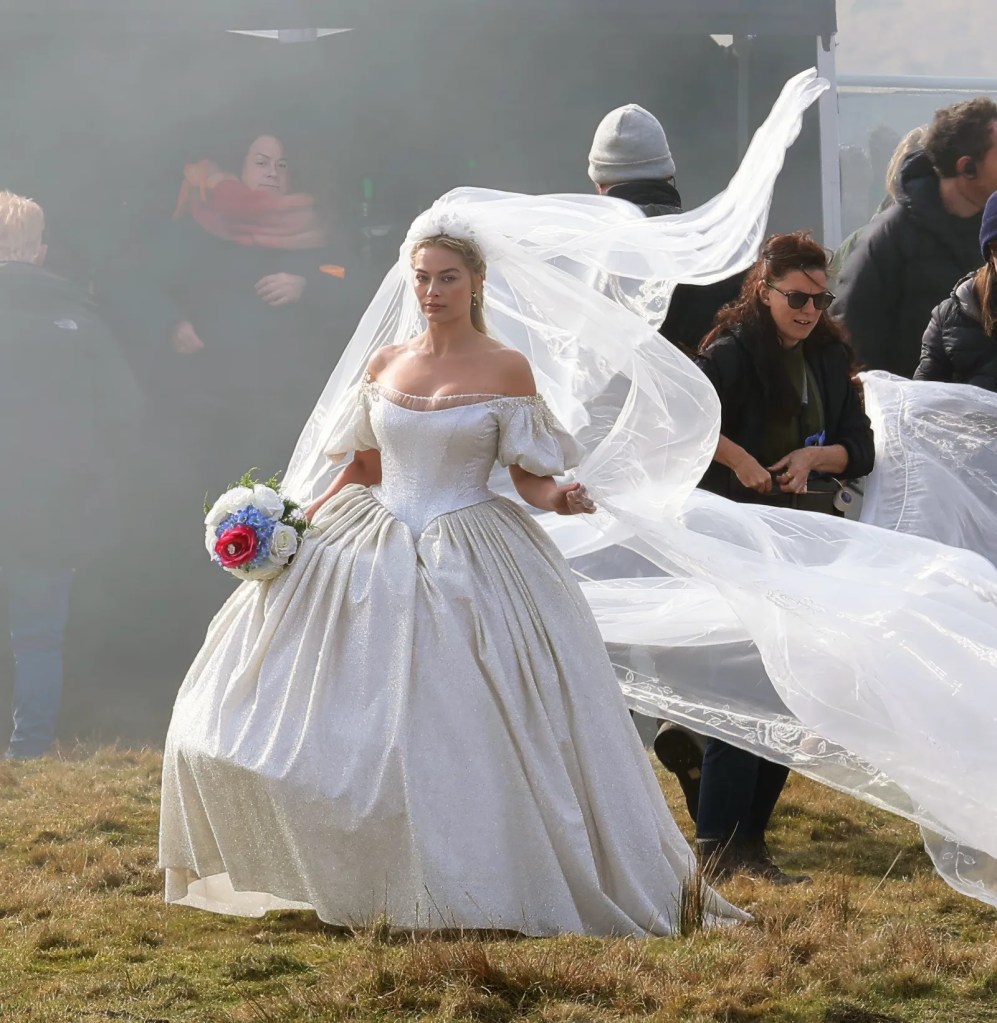
Queen Victoria popularized the white wedding dress in the 1840s, after her royal wedding. Prior to that, the public did not wear white to get married. They simply donned the best clothing they owned. “Wuthering Heights” takes place over half a century before this fashion switch occurred. No character in that book would have ever worn a white wedding dress. Now, the argument could be made that a white dress is worn to show a modern audience who is not well-versed in the history of wedding dresses that Cathy is getting married. But, come on. Have some respect for historical accuracy. If a movie is supposed to take place from the late 18th century into the 19th century, then it should be held to that standard.
I’ll simplify this in pop culture terms: “Wuthering Heights” takes place when “Hamilton” takes place. Think: the dresses worn by Angelica Schuyler for the majority of the musical. There is a noticeable bodice and full skirt. If you go slightly forward in time, to the early 1800s, that’s Regency, baby! A.K.A., you’re in “Bridgerton” territory. Empire waistline, light colors.
Yet rather than sticking with either of these styles, they have chosen to go in a completely different direction. Think: “Little Women.” The elaborate dresses that Emma Watson and Florence Pugh wear. Off the shoulder with a curving corset.
Using historically inaccurate clothing should not become acceptable when the time period is further off. The silhouettes of different centuries and the decades within are incredibly distinct. Someone looking at an old portrait might just see someone from a long time ago, but for those versed in the styles of the past, it is all too easy to spot the difference between a gown from the 1770s versus the 1860s.
An example for how jarring this is in relatable terms: imagine a movie taking place in the 1980s. People are using words like “rad” and saying “gag me with a spoon.” Hairspray is in the air. You would be quite confused to see someone walk into a scene decked out in 2000s or 2010s fashion. Regina George and Coldplay hipsters have no place in “The Breakfast Club.” In the context of “Wuthering Heights,” the anachronisms are just as noticeable.
None of these changes make sense. It feels entirely disrespectful to Emily Bronte. This isn’t some new adult book that was written in the 2010s, where the main characters have cringey dialogue and a poorly written storyline. This is a classic. A book so good that it has withstood the test of time. How many other books from the era retained popularity and developed a cult following to the level of “Wuthering Heights”? Emerald Fennell has the potential to absolutely ruin this adaptation, and if her current actions are anything to go by, this film will be a train wreck. And not the kind that you can’t help but watch.


 Masuk Free Press
Leave a comment