
I used to be sane before I began playing Balatro. I remember I could look at a deck of cards and go, “Wow, a deck of cards,” and not immediately think of Balatro. I could look at a banana and think, “Huh, that’s an awfully banana-looking banana, ” not Balatro. There are so many things Balatro has ruined for me. Balatro is not just a videogame, it is a psychological weapon designed to kill time so efficiently that it terrifies me. That’s why I can say with full confidence that Balatro may just be one of the best things I have been able to bear witness to in my fifteen years of life on this planet.

Maybe I’m getting ahead of myself, though. Most of you probably aren’t even sure what I’m talking about, and are saying, “What is a Balatro? Why should I even care?” To answer your question, Balatro is a video game created by indie developer LocalThunk and published by PlayStack, and the premise is simple: poker solitaire. Balatro’s gameplay is also quite simple; play a poker hand, which scores you chips (in blue), multiplied by your “mult” (short for multiplication, in red), and receive a final amount of chips ( underlined in green). You will need a certain amount of chips to beat a round, also known as a blind (underlined in yellow.). There’s a small challenge, though; you don’t have infinite chances to beat the blind – you have limited discards and hands to play (underlined in purple), and if you can’t get the number of chips the game wants you to, tough luck, game over. To add on, every three rounds is a boss blind, meaning that you’ll have to adapt to an issue the game hands you. One example is the Window, which disables all cards with the diamond suit. While Balatro does offer a way for you to reroll boss blinds with vouchers (which I’ll touch on later), if your deck consists of diamonds, well, say goodbye to your run. Once you beat a blind, though, you can purchase items from a shop with reward money you are granted at the end of the round.
This is where one of the most fun parts of the game comes in — the jokers. You have five joker slots to fill up, which can be purchased from the shop. The jokers each give their own zany effect. Some are simple, like the basic joker, which gives +4 mult on his own, but others have extreme modifications to how you play, and how your deck will be organized. Hanging Chad, for example, replays your first played card twice, while Photograph gives double mult to the first played face card. Keep these two in your joker slots, play a face card, and watch the magic happen as the numbers climb high. Other jokers give more money, like Golden Joker, which gives +4 money at the end of each blind, or an adjustment, like Four Fingers, which allows you to play flushes and straights with only four cards.
That isn’t the only feature of the shop, though. You can enhance your cards with helpful properties like a lucky card, which gives a one-in-five chance to grant +20 mult. Buy vouchers with passive abilities like one that adds an extra hand you can play, another that increases your chances of finding tarot cards, or, as I mentioned earlier, one that allows you to reroll the boss blind. Now, all of this may seem overwhelming, but a good thing about Balatro is that it makes sure that all of these are not only explained to you in a very useful and surprisingly well-crafted tutorial, but are all straightforward to the player as well.
As if the game couldn’t get better, the music is absolutely phenomenal. The main theme is a brief loop that somehow never gets boring, and there are slightly edited versions of that loop that seamlessly transition for each part of the game. Did you open a celestial pack to upgrade your Flush? The theme switches to an even more blurry, astronomical version. When you lose, the music winds down, and when you start another game, it winds right back up, and let me emphasize – it never gets boring. The music sounds psychedelic, with long synth drones and calm drum beats that continue onward with no end.
It’s hard to explain what exactly makes Balatro so addicting. I wish it was easy to give a one-word, concise answer about its hypnotizing gameplay, but all of the mechanics work together so effectively that it’s puzzling. The deckbuilding aspect of Balatro is extensive, with many combos and ways to beat the game, and for the game’s size and grandeur, it’s astonishing how well-designed it is. Every run, win or loss, is seamless. There are no stops or halts that ruin your flow besides the win or loss screen; you just keep playing cards and buying jokers as fast or as slow as your heart desires.
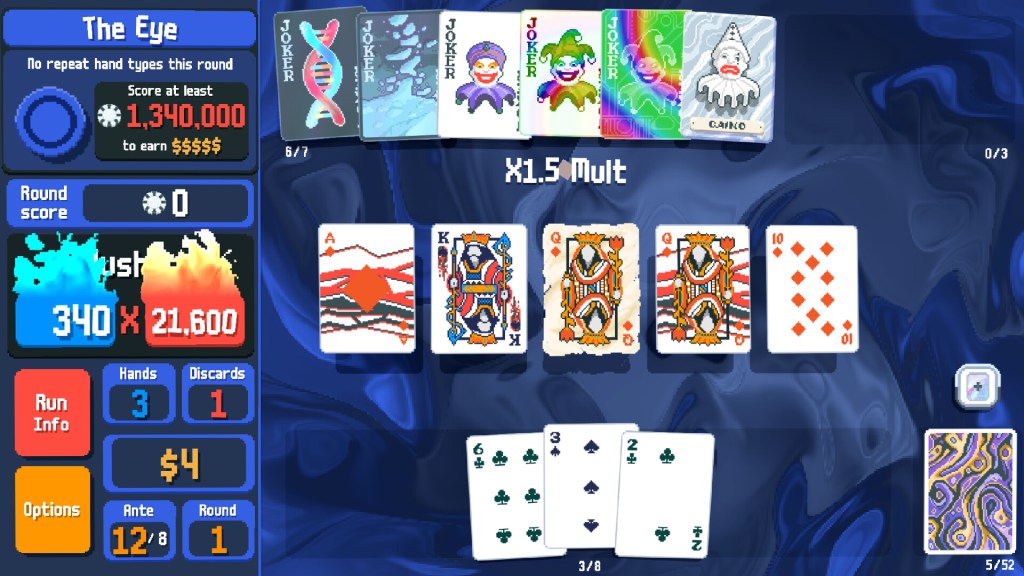
But nothing is perfect, not even Balatro. It, unfortunately, suffers from the issue of repetitive gameplay, and although I will concede that it does do a great job of preventing these issues from appearing, playing the game for a few minutes too long will wind you harder than doing laps around a track field. There is also a slight learning curve — your first playthrough of the game for the first time will certainly have over five critical mistakes that will make you lose, and this could be a major reason some are not a fan of the game.
Finally, the game is ultimately controlled by luck. While yes, a game about poker being luck-based is really surprising, this does take away a little from the experience. If you get a bad seed, enjoy playing with terrible jokers and not getting past mid-game, but if you get a good seed, the game can be really fun.
Even with its negatives, there’s no question why this game was nominated for Game of the Year at this year’s Game Awards (essentially the Oscars for video games). Balatro started as a game only intended for developer LocalThunk’s close family and friends, but sprung into something much more than that. It is a magnificent work of art that has won over everyone’s hearts across the globe.



 Masuk Free Press
Leave a comment