
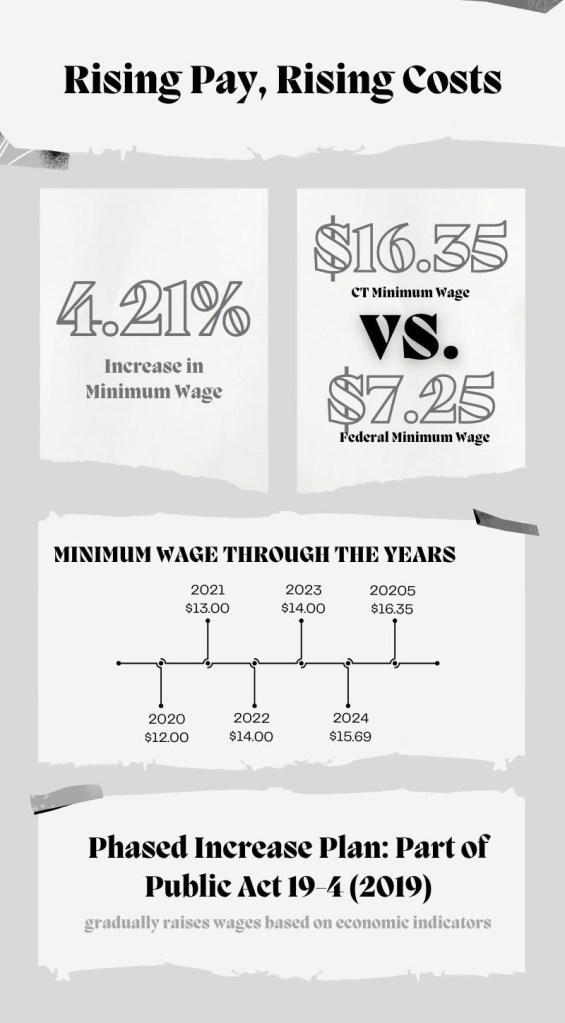
On January 1, 2025 the minimum wage in Connecticut rose to $16.35 per hour, reflecting a 66 cent increase from the previous amount of $15.69. This adjustment is part of a phased plan that has been gradually implemented over several years, aimed at addressing the economic challenges faced by low-wage workers. As the cost of living continues to rise, this increase is seen as an essential move by the state to provide much needed relief to its workers, particularly those employed in industries that have historically low wages. This shift is especially important as Connecticut’s economy continues to adjust to the pressures of inflation and the growing cost of living
This wage increase follows the trajectory set by the state’s earlier efforts, specifically the Public Act 19-4 in 2019. Signed into law by Governor Ned Lamont, this act connected Connecticut’s minimum wage to key economic indicators, with a focus on adjusting it over time to keep up with the rising cost of living. At the time of the act’s passage, Connecticut’s minimum wage stood at $11 an hour, which was considered an insufficient amount to meet the demands of living in Connecticut at the time. Since then, the state has made incremental increases to the minimum wage, with the most recent adjustment being the increase to $16.35 per hour in 2025.
The phased approach to raising the minimum wage allows for a gradual adjustment, ensuring that businesses, especially small ones, have time to adapt to the higher labor costs. However, despite these efforts, workers argue that this increase is still not enough to close the gap between the wages of low-income employees and the rising costs of basic living expenses. Connecticut, with its high housing costs, expensive healthcare and transportation, remains one of the most expensive states to live in. The 2025 wage increase is seen as an attempt to help workers keep pace with these escalating costs.
For workers in industries like retail, hospitality, and healthcare, which are among the largest employers of minimum wage labor, this wage increase is particularly important. These industries rely on low wage workers to sustain operations, but historically, the wages in these jobs have not provided workers with the financial security they need to live comfortably. By increasing the minimum wage, Connecticut aims to provide some relief to workers struggling with financial burdens.
However, while minimum wage increase is a step in the right direction, critics of such wage hikes argue that it may lead to unintended consequences. Some worry that businesses, particularly small ones, will struggle to absorb the higher labor costs, leading to reduced hiring, layoffs, or even closures. Especially, in industries like retail and hospitality, where profit margins are already small. Smaller businesses may find it challenging to pay higher wages while maintaining profitability, potentially leading to consequences on the workers.
On the other hand, proponents of minimum wage increases argue that the benefits, such as increased worker morale, higher consumer spending, and a reduction in government assistance programs, outweigh these potential drawbacks.
As of 2025, with the new increase, Connecticut’s minimum wage now sits at $9.10 higher than the current federal minimum wage of $7.25, which has not seen an increase in over a decade. The federal minimum wage has been a point of contention for many years, as it is widely regarded as inadequate in addressing the basic living needs of American workers. The gap between state and federal wages highlights the disparities that exist between different regions in the country. States like Connecticut, which have high living costs, need higher wages to help workers keep up with inflation and rising prices. Meanwhile, states with lower costs of living may not face the same urgency for wage increases, making it a complex issue that varies greatly depending on regional economic conditions.
Connecticut’s decision to raise the minimum wage to $16.35 per hour in 2025 reflects the state’s ongoing commitment to addressing economic inequality and providing support for low wage workers. While this wage increase is a positive step, it remains to be seen whether it will be enough to fully address the financial struggles of workers in the state. With the rising costs continuing to put pressure on individuals and families, the debate around minimum wage adjustments will likely remain a key issue in Connecticut’s political and economic landscape for the foreseeable future.



 Masuk Free Press
Leave a comment