
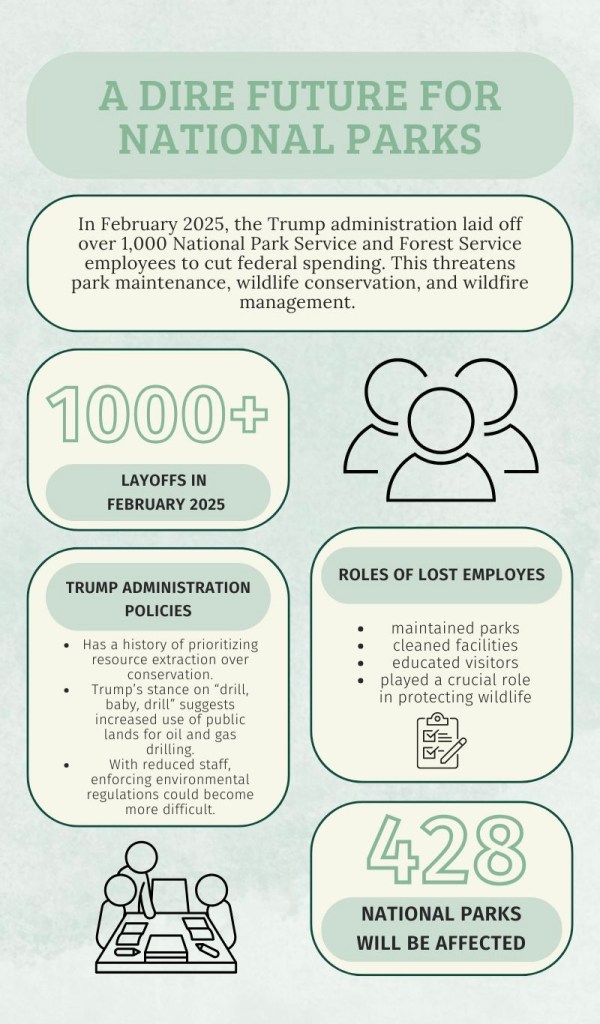
The week of Feb. 9, 2025 we saw the loss of more than 1,000 employees from the United States Forest Service (FS) and the National Park Service (NPS) as a result of the Trump administration’s effort to downsize the federal government and reduce spending. These actions were executed by the newly established Department of Government Efficiency led by Elon Musk. While the motives behind this are debatable, the consequences for the nation’s natural treasures are undeniable.
These 1,000 employees maintained and cleaned parks, educated visitors and performed other critical functions. For the national parks, this represents a major step backward. Advocates warn that the permanent loss of staff will leave hundreds of parks understaffed and ill-prepared to handle the increasing demand of the more than 325 million visitors who travel to the nation’s 428 parks every year. The loss of these workers is a direct blow to the National Park Service.
The impact of these cuts will be long-lasting for the country’s National Parks. These spaces have already faced challenges in upkeeping their infrastructure for years, and now, with the loss of 1,000 employees, the situation is likely to get worse. The National Park Service’s budget has already faced years of pressure due to increased visitation and rising maintenance costs. With fewer employees to tend to the critical needs of conservation and park maintenance, national parks will struggle to stay open, and the natural environment and wildlife within these parks will become increasingly vulnerable.
Key infrastructure projects, such as repairs to historic sites or the restoration of damaged ecosystems, may be delayed or abandoned altogether. Many parks have already reduced their hours or limited services in recent years due to staffing shortages. These layoffs will only serve to exacerbate preexisting issues, and in the worst-case scenario, some parks may need to scale back or even close entirely, drastically limiting public access to treasured spaces. In places like Yellowstone or the Grand Canyon, where tourism drives local economies, this could have a ripple effect on surrounding communities, potentially hurting tourism and local jobs.
For wildlife, the situation is even more concerning. The NPS and FS play a critical role in managing ecosystems, monitoring wildlife populations, and addressing environmental threats such as invasive species and climate change. With fewer staff members, it will be more difficult to manage these crucial tasks. Park rangers who are responsible for overseeing the protection of endangered species may have fewer resources to effectively protect and keep track of wildlife. Similarly, forest managers responsible for controlling wildfires and mitigating damage from climate change may be overwhelmed due to short staffing, leaving both forests and wildlife at risk.
A particularly concerning example of the far-reaching consequences of these cuts is in wildfire management. The U.S has already experienced devastating wildfires this year and in recent years. The FS has been on the frontlines of combating these fires and protecting forest ecosystems. With fewer forest rangers, managing wildlife risks will become more difficult, putting both wildlife and our communities at greater risk.
An article released by the National Parks Conservation Association in late January highlighted the negative connotations of the Trump administration orders, including threats to advances in renewable energy, the protection of endangered species, and the enforcement of hunting regulations. These concerns are legitimate, with drastic budget cuts and loss of jobs, many fear that the commitment to conservation could be significantly weakened.
Trump has made it no secret that he wants to “drill, baby, drill,” meaning he wants to utilize U.S. federal lands for the extraction of natural resources. This mass layoff makes national parks even more vulnerable, as they are owned and managed by the federal government. Trump already has backed an anti-environmental agenda in his first term by withdrawing from the Paris Agreement, an international treaty that aims to reduce greenhouse gas emissions and slow climate change. So, it is unclear what his plans are for these national parks.
Despite this, the park service now says it is reinstating about 5,000 seasonal jobs that were initially rescinded last month as part of a spending freeze ordered by President Donald Trump. This, in turn, will help alleviate some of the pressures of understaffing. However, the long-term effects of the 1,000 permanent layoffs cannot be mitigated so easily. The overall reduction in permanent staff poses a far more severe challenge to the health and preservation of these parks.
These layoffs of over 1,000 NPS and FS employees represent a clear crisis for our national parks, but there are still steps we can take to help preserve these vital lands. Donations to nonprofits like the National Park Foundation and volunteer work can make a tangible difference in maintaining and protecting these spaces. The responsibility for preserving our national parks and forests does not rely solely on the shoulders of the federal government. Communities, organizations and individuals must work together to raise awareness about the importance of conservation and the need for continued investment in our public parks. While these cuts were the result of budgetary constraints and broader political priorities, their impact on both the parks and the wildlife that depend on them is undeniable. It is up to the public to step up and advocate for the future of these national parks and forests.


 Masuk Free Press
Leave a comment