
In the two months since the election, President-elect Donald J. Trump has made waves in the media cycle, presenting controversial plans and making controversial promises for his next four-year term. This includes scrutinized cabinet picks, criticized immigration policy and most recently, what some political commentators are calling modern-day “Manifest Destiny.”
The story begins years prior, in a world before COVID-19, during Trump’s first term as president. In 2017, sources close to Trump revealed to Reuters, a news agency, that Trump was spearheading serious talks with his team, investigating a potential purchase of Greenland from its governing nation of Denmark. Greenland is considered an “autonomous territory” of the Kingdom of Denmark. This means that the Greenlandic government has the power to legislate within the island, but Denmark still controls external affairs and has oversight over the internal affairs of Greenland.
Trump is not the first United States leader to float the idea of purchasing Greenland. Several times in American history, the idea of buying Greenland was on the table. For instance, in 1867, Secretary of State William H. Seward and allies discussed the possibility of acquiring the icy island for America. This notion was shot down by opposition in Congress. Then, in 1946, the U.S. offered Denmark $100 million USD (~$1 billion accounting for inflation) in gold to purchase Greenland. This was at a time when the acquisition of Greenland was thought to be of utmost military importance, with a Cold War against the USSR looming. However, the offer was rejected by the Danish Foreign Minister, who called the idea “absurd.”
Now, in the 21st century, Trump is reviving these ambitions for the U.S. Following his re-election in November, Trump has relentlessly spoken out about the “absolute necessity” of buying Greenland from Denmark, citing concerns about national security.
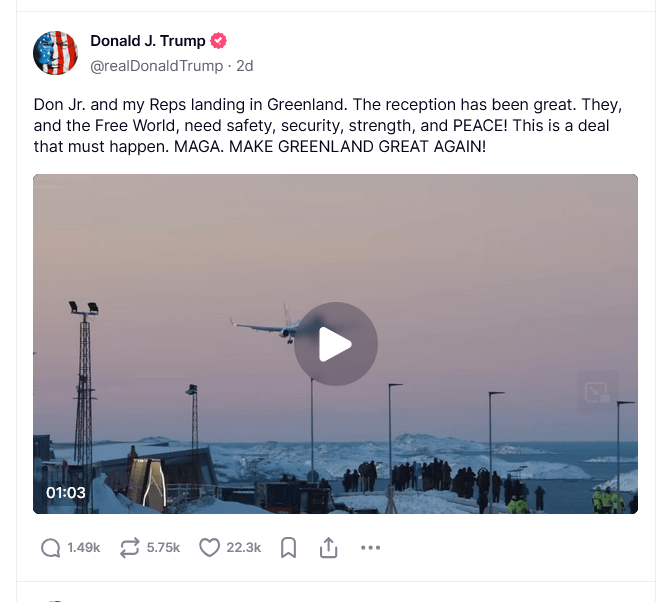
Similarly to his Greenlandic ambitions, Trump has expressed interest in reclaiming the Panama Canal from the Central American nation of Panama. In December of last year, Trump expressed anger at the “unfair and injudicious way” that Panama was treating U.S. ships (referring to the rates that vessels are charged when crossing the canal). He pushed the issue throughout December, even centering his Christmas Truth Social post around it.
The canal is a vital waterway for international shipping, and control could mean a great degree of power over trade near the Americas. Originally built by the U.S. in the early 1900s, the Panama Canal was under American control for decades once completed. The discussion around the Panama Canal is especially topical given the recent death of former President Jimmy Carter, the man who gave up control of the canal to Panama in 1978.
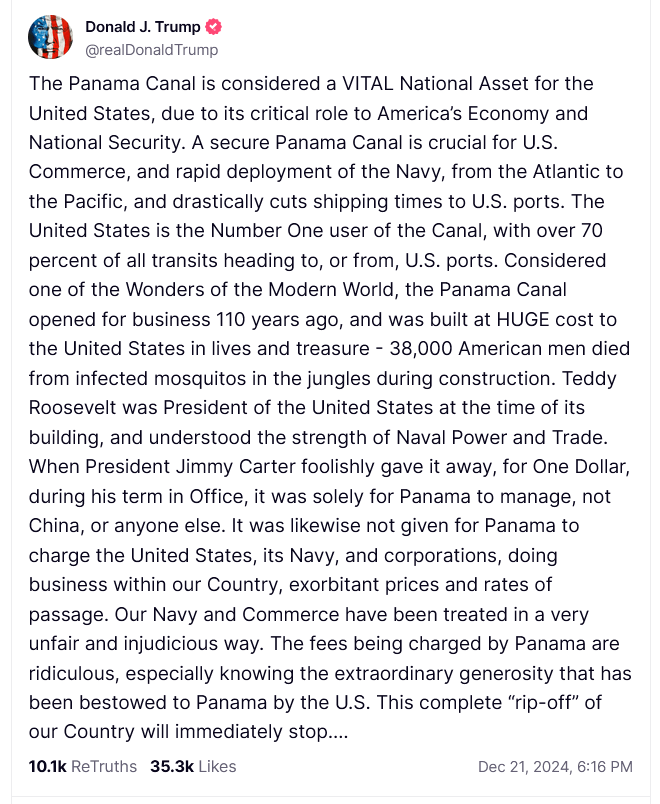
Trump escalated the issue further this January, when he implied at a press conference that a military response is on the table when it comes to the acquisition of the Panama Canal and Greenland:
“I’m not gonna commit to that [ruling out military or economic coercion]. No. It might be that you’ll have to do something,” he stated at the conference.
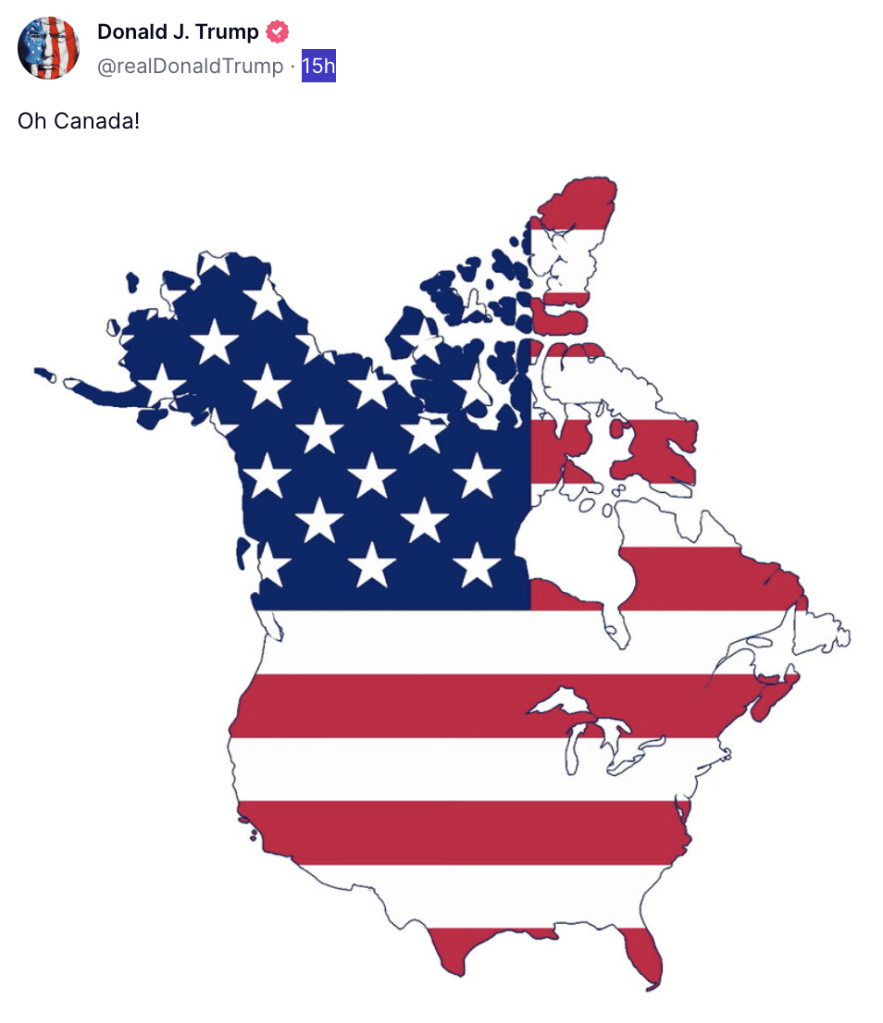
These initiatives all coincide with other, novel ideas from Trump, such as Canada being integrated into the U.S. as the 51st state. Making headlines once again in December, it was reported that Trump “joked” with now former Prime Minister Justin Trudeau about the 51st state proposal. Canada’s Public Safety Minister, Dominic LeBlanc, was quoted by the Associated Press (AP) as saying: “The president was telling jokes. The president was teasing us. It was, of course, on that issue, in no way a serious comment.”
However, LeBlanc’s attitude towards the issue shifted in early January, after more than a month of Trump’s repeated recitation of these “jokes.”
“The joke is over,” stated Leblanc to AP. “It’s a way for him, I think, to sow confusion, to agitate people, to create chaos knowing this will never happen.”
Finally, Trump’s most recent “plans” to reshape the U.S. map involve altering toponyms (the names of places). During a news conference on Jan. 7, one day after the November election results were certified, Trump mentioned plans to rename the Gulf of Mexico to the Gulf of America.
“The Gulf of America. What a beautiful name,” said Trump.
Alongside media sources dubbing this a revival of the 19th-century ideal of Manifest Destiny — the belief that The U.S. is destined to expand and the driving force of Westward expansion — some cite an alternative motivation for Trump’s newfound expansionist ideology. Political commentators like Andrew Latham, Opinion Contributor for The Hill, claim that this is just another instance of Trump utilizing the absurd and extreme to manipulate the media and consolidate support.
“By framing his remarks as a revival of Manifest Destiny, they misunderstand his intentions and reinforce the dynamics of Trumpian politics,” wrote Latham for The Hill. “Trump thrives on this dynamic, turning outrage into fuel for his political brand. The real threats to American stability — polarization, inequality and eroding democratic norms — receive far less attention than Trump’s provocations.”
This stance by Latham is reflected by other political commentators, as well as politically engaged users on social media.

With four years of Trump’s presidency on the horizon, supporters are looking forward to a strong conservative voice spearheading the nation. Many fans of Trump see these extreme positions as entertaining, solidifying their support of the President-elect. But in light of these controversial two months, detractors are already becoming aware of just how turbulent these next few years will be for them.



 Masuk Free Press
Leave a comment