
Virtual High School, also known as VHS — a program where students can take online classes that don’t fit into their in-person schedule or aren’t offered at their high school. Many Masuk students have taken VHS courses over the years, and, in theory, it seems like a good idea. But no in-person interaction, no lectures, no conversations… What’s it like actually taking one of these classes?
I started VHS AP Lit this year after the in-person class couldn’t fit into my schedule. One of the first assignments we had was a questionnaire asking when, during the school day, we had time to complete this classwork. I didn’t have a study hall, but I did have two late arrivals. While I wasn’t planning on waking up early to finish VHS Lit work before school, just a few days in, that’s what I found myself doing.
“I would say [the workload] was like three times what a normal class would be,” said senior Sawyer Judge, who started and then dropped VHS AP Macroeconomics his junior year.
While this might seem like an exaggeration, in my experience, it’s really not. And it seems to be a consistent problem throughout AP VHS classes. The VHS Lit syllabus, for instance, says the coursework averages about 10 hours a week. With our block schedule, this would translate to a 3-4 hour-long class, plus another one or two hours of homework. This is extremely unrealistic for high school students to manage.
Like Judge, I really wanted to drop the class just a few weeks in. But, in my case, English is a core class. My counselor strongly opposed me dropping it because AP English Literature would be beneficial to have on my transcript. And I did agree with that part — I wasn’t going to drop a class knowing colleges wanted to see it. So, I had no choice but to keep going.
Oftentimes, I found myself coming home from practice and going straight to my computer, desperately trying to submit any work before the 11:59 p.m. due date. The format of the VHS website doesn’t help with this. With completely separate pages for the assignment directions, file uploading, group discussions and viewing grades and feedback, staying organized and making sure you have completed all of your work is much more difficult than it is on platforms like Google Classroom.
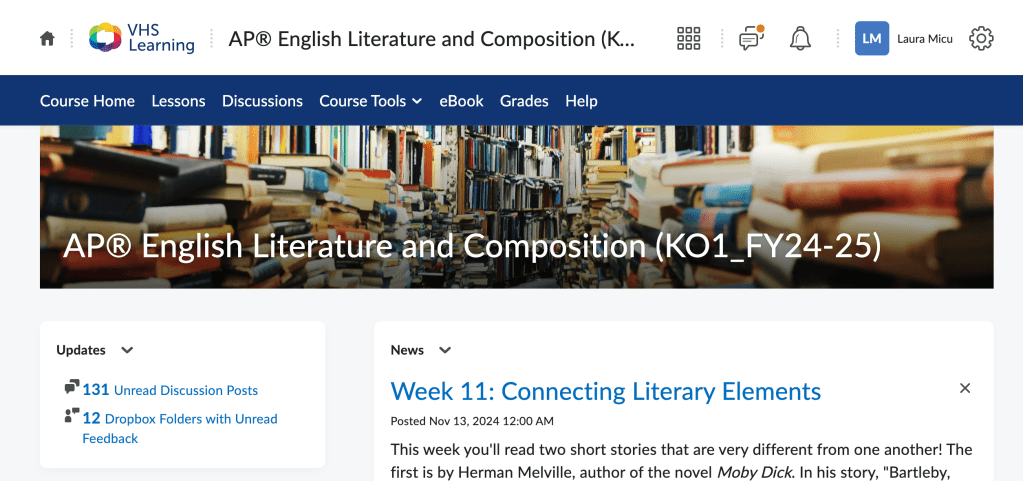
VHS classes also run on a peculiar schedule. All the assignments for that week open at 12:00 a.m. on Wednesday, and close at 11:59 p.m. on the next Tuesday. This splits up my school week in a way that I wasn’t at all used to. And with five or more assignments being up at the same time, I found it hard to stay organized and remember what I had and hadn’t done. Another big issue was the chaotic stress of this setup. Normally, I reset on Sundays and map out my weekly workload from there. While I’m trying to become more proactive now, especially with the pressure of Nov. 1 deadlines gone, during my first weeks on VHS I found myself putting off all the work for the last two days. Obviously, this resulted in an extremely stressful time, leaving me too exhausted to even open the VHS tab for the rest of the week, causing me to leave all the work off for the last two days again…
“I had to do [the work] outside of school,” Judge said. “I actually didn’t even have a study hall that year, so on top of all the work I was getting from my other classes, it was just like, way too much.”
I have no idea why VHS chose to use Tuesday to Tuesday weeks, but it definitely was a hard adjustment to make when piled on top of hours of work and stress. And for some, like senior Nicholas Kauke, the reputation of VHS was enough reason to not even try taking a class.
“I decided to teach myself one of the hardest AP classes,” Kauke said, referencing AP Physics C. “Self-taught, passed. Because I heard VHS was too much work and my friends said not to.” Kauke also mentioned, “I heard that there was a lot of summer work.”
In addition to the workload, a huge controversy about VHS classes is that they do not count towards your weighted GPA. For students like myself who would’ve appreciated the boost from an AP class, this is very frustrating. The class seems like a lot of work for very little reward. On the other hand, if you just want to take an elective to see if you like it, this can be a positive.
Diving into specific features of VHS, it was obvious that the platform tried to make up for the lack of real-life interaction. Classes are very heavy in “discussions”, which are basically just prompt answers that you have to post to the entire class. From there, you have to comment on other people’s responses, as well.
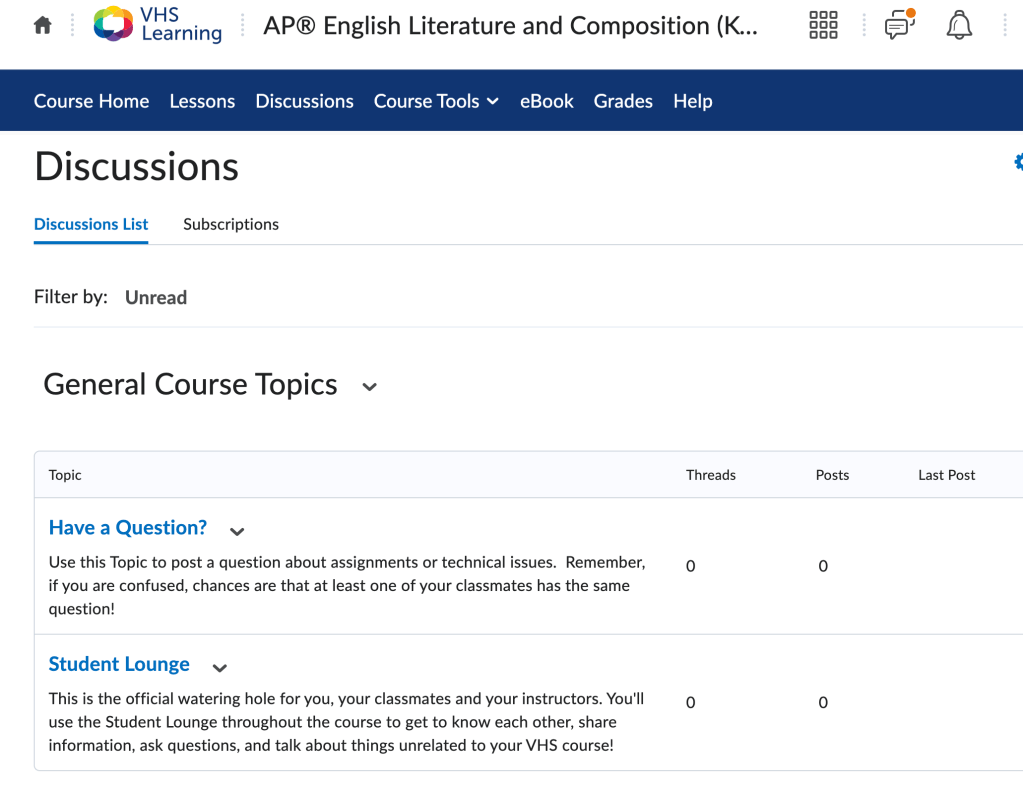
Judge explained, “Not only was there the normal amount of work that any class would make you do, but they have graded discussions they would make you do. And they were saying that it was at least, like, three comments per activity. And, also, they don’t make it clear what exactly you have to do, like how thorough each one would have it be.”
The discussions also just don’t fulfill their purpose. Senior Emma Hannum, for example, is taking VHS Mandarin. Learning a language requires more than just written discussions, and VHS doesn’t offer this.
Hannum said, “I think the only thing that I would change is maybe implement some sort of online meeting with the whole class. Especially when learning a language, having a chance to practice speaking and listening with other students is very useful.”
But while many of us have had negative VHS experiences, the platform can definitely still be positive. Hannum was able to continue learning Mandarin after moving to Masuk, even though we don’t offer that language in school.
“I would definitely recommend taking a VHS course if someone is interested in a course that is not necessarily offered at Masuk,” Hannum explained. “I think it provides a great opportunity for students to learn something they may not have the opportunity to otherwise.”
This is true. After all, I wouldn’t have been able to take an AP English course at all this year if it wasn’t for VHS. And as for workload, even though many have had bad experiences, it really depends on the class.
“I think the workload is less than my regular courses.” Hannum continued, “The assignments are usually easy to find time for since I have a week to do all of them.”
With only eight periods a day and relatively restricted elective options at Masuk, VHS is definitely a good option for those looking to explore more topics of interest. It’s hard knowing things like career goals after having little exposure to diverse courses.
All in all, take this as a warning. Your experience will differ drastically on a class-to-class basis, but not all VHS courses are manageable with a busy high school schedule, especially if you don’t have a midday study hall. VHS can be very helpful with schedule conflicts and courses that Masuk doesn’t offer. But if you don’t need to take the class, or you aren’t passionate about the topic, staying away from this platform could be the better choice.

 Masuk Free Press
Leave a comment