
The joy of bringing a child into this world is often thought of as an essential milestone in a person’s life. This aspiration to have children has most commonly been seen through a stereotypically feminine lens in the past. But times are changing.
Though at a cursory glance the desire to settle down and start a family appears as a maternal value, this is no longer the truth.
Recent data from Pew Research Center shows that, “While 57 percent of young men say they want children one day, a smaller share of young women (45 percent) say the same.”
This leads to the question, what is the explanation for this large imbalance? And can the answer be found at Masuk among its students?
Having children may seem very far away for the average high school student, but nonetheless, this dream is socialized from a young age. In the past, future children would have been primarily at the forefront of women’s minds, not men. So what has changed?

“I mean, when you look at the 1950s, there was definitely kind of this traditional idea that the man provides for the woman, and the woman has to stay at home and cook and clean. That culture has definitely changed. And that’s maybe why the statistics are shifting,” said freshman Maddox Marizalde.
Marizalde’s point seems to have some grounds. Data from Pew Research published in 2018 stated, “The median age at which women become mothers in the U.S. is 26, compared with 23 in 1994.”
Part of the shift is attributed by Pew Research to “declines in births to teens,” as in a decrease in teenage pregnancy. However, this may not be the only variable affecting women.
It would be impossible to investigate this topic without looking at the history of feminism in the United States. The movement, beginning in the nineteenth century, seeks to expand women’s rights and empower women to pursue goals that were once thought impossible.
The concept of female independence fueled the second wave of feminism in the U.S. (1963-1980’s as outlined by history.com). The era went against traditional gender roles, encouraging women to find fulfillment outside of their homes and roles as wives.
Influential female activists spearheaded the movement, such as Betty Friedan with her acclaimed book The Feminine Mystique. The central concept of the book was defined by Friedan and her publisher W.W. Norton & Company as “a belief that ‘fulfillment as a woman had only one definition for American women after 1949—the housewife-mother.’” This belief is what the book set out to disprove. The push against women being stagnated as housewives and nothing more could have indirectly pushed them away from motherhood as well.
Conversely, the perspective of young men in our times must also be considered when broaching this topic.
Evidence of a rise in active fatherhood can be observed with single fathers. Although single-motherhood numbers are reaching startling levels (one out of five children as reported by singlemotherguide.com), single fathers are far from uncommon.
Pew Research again reports that, “The number of single father households has increased about ninefold since 1960, from less than 300,000 to more than 2.6 million in 2011.”
In addition, stay-at-home dads are also rising in commonality: “The share of fathers who are stay-at-home dads increased from four percent in 1989 to seven percent in 2016.”
Both of these data points showcase men taking a larger responsibility as parents. Previous years have carried a stigma with father figures; the popular theme in prior decades is that the father should be the secondary caregiver. This stands as a societal norm that has been left in the past.
“I feel even if I have kids with my wife one day, or if I adopt, I feel it’s good to give the kids a good home and provide a life for them,” said sophomore Nathaniel Leslie.
This may tie back to the ideologies pushed in the second wave of the feminist movement. As women moved away from their traditional gender roles, men moved in the opposite direction, assuming the roles left by women and thus mirroring the movement.
“I think it’s actually refreshing. I think it’s wonderful that young men want to assume that dad role. I think it’s beautiful. Maybe more women want to focus on their career first, and their lives first maybe, so we’re seeing a shift,” said Richelle Crino, teacher of Masuk’s child development elective.
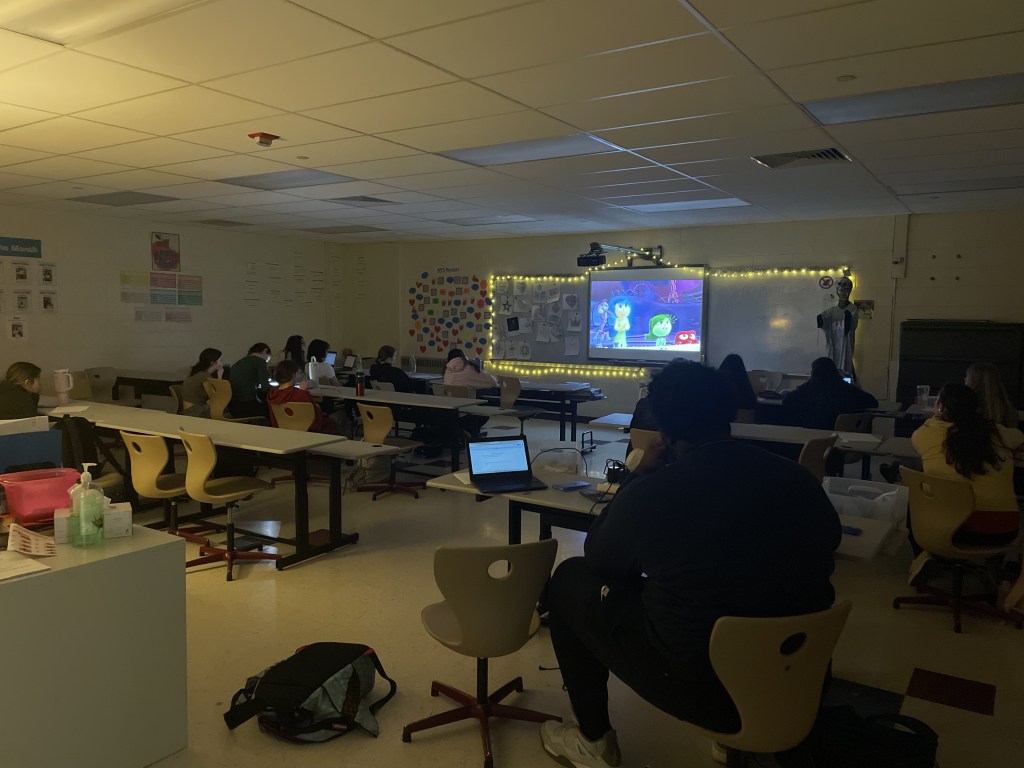
Moreover, some boys at Masuk associate fatherhood with fun.
Junior Jeremy Gniadek said, “More guys wanna be dads so you can do things with [your child], like go fishing with them and pass things on.”
The ideal reflected by Gniadek may point towards the fact that men with positive relationships or experiences with their father would want to have a chance to experience that relationship again through fatherhood.

But in the end, not many high schoolers are concerned about having children. Amongst high school discussions, future familial plans do not seem to have much presence.
“I’m a freshman, so all the boys I know are freshmen, and they are not talking about wanting children. But I don’t expect them to. I mean, I don’t go around talking about it either,” said Adrienne Crowley.
Ultimately, there are many variables that may be influencing the younger generations when it comes to the gender divide of wishing to experience parenthood. No matter what the cause may be, it is undeniable that gender roles and beliefs in our modern society are constantly shifting, with some shifts being certainly more surprising than others.





 Masuk Free Press
Leave a comment